A new NAR survey shows consumers’ preferences for neighborhood amenities.
Americans are placing greater value on homes in close proximity to nearby shops, cafes and parks—and they may even pay more for such properties, according to the National Association of REALTORS®’ newly released 2023 Community & Transportation Preferences Survey .
Seventy-nine percent of respondents rate walkability as “very” or “somewhat” important, and 78% say they’d pay more for a home in a walkable community, the survey shows. Young adults prioritize walkability the most, with 90% of Gen Z and millennial respondents indicating they’d pay more for a home in a walkable community; a third say they’d “pay a lot more.” The survey did not specify how much more they’d be willing to pay.
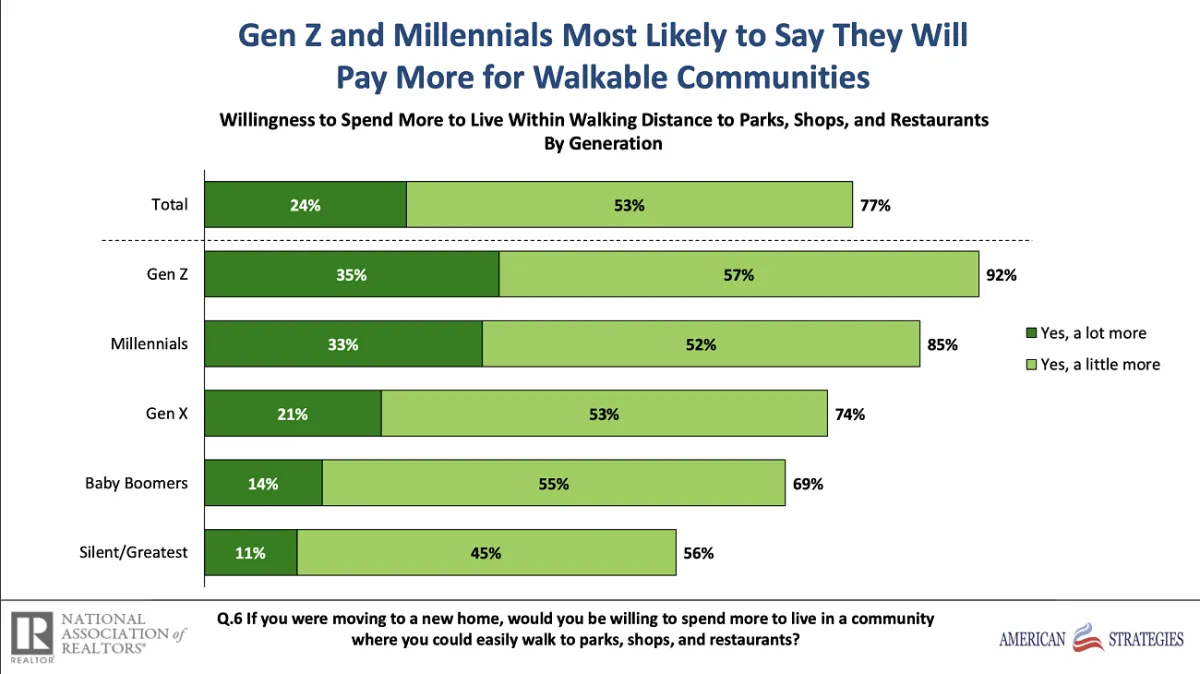
Respondents to the NAR survey who already live in a walkable community report feeling happier with their life, the NAR survey finds. But consumers also value other neighborhood virtues. Overall, the NAR survey found the following as the most preferred home and community qualities (ranked in order):
- Low levels of crime
- Walkable to shops and restaurants
- Large house
- High-quality public schools
- Large yard
- Short commute
Survey respondents say they believe the government has a role to play in helping their communities become more desirable. Consumers identified the following as the top issues they’d like the government to prioritize:
- Maintaining and repairing roads, highways, freeways and bridges.
- Expanding public transportation, including trains and buses.
- Building more roads and expanding existing roads to help reduce traffic congestion.
- Providing convenient alternatives to driving, such as walking, biking and public transportation.
- Making it easier to develop communities where people can walk, work or shop.
Looking Around: What’s Near the Home?
Walkability became more of a focus during the COVID-19 pandemic, but demand has only grown since. In fact, NAR’s biennial survey shows a modest uptick in consumer demand for homes that offer greater walkability to surrounding community areas. “With COVID in our rearview mirror, this study shows that substantial demand for walkability persists for Americans of all ages,” says NAR President Kenny Parcell.
About half of the survey’s 2,000 respondents say they prefer a walkable community and shorter commute, even if it means living in an attached home, such as a townhome or condo, or having a smaller yard. Indeed, the majority of survey respondents say they prefer a house with a small yard over one with a larger yard that is further away from amenities.
The NAR survey also uncovered some generational differences in these preferences.

The NAR survey looked at the following community and transportation traits that consumers consider when deciding where to buy a home: walkability; commute length and proximity to highways; access to public transportation; and access to bike paths. Here’s how those traits were valued by respondents:
Sidewalks and places to take walks
- Very important: 50%
- Somewhat important: 34%
Being within an easy walk of community amenities
- Very important: 41%
- Somewhat important: 38%
Being within a short commute to work
- Very important: 40%
- Somewhat important: 32%
Having public transit nearby
- Very important: 36%
- Somewhat important: 29%
Easy access to the highway
- Very important: 34%
- Somewhat important: 40%
Bike lanes and paths nearby
- Very important: 22%
- Somewhat important: 33%
Source: NAR: Melissa Dittmann Tracey